
On the internet, you will find plenty of tools for checking disk space usage in Linux. However, Linux has a strong built-in utility called ‘df‘.
The ‘df‘ command stands for “disk filesystem“, it is used to get a full summary of available and used disk space usage of the file system on the Linux system.
Using ‘-h‘ parameter with (df -h) will show the file system disk space statistics in “human-readable” format, which means it gives the details in bytes, megabytes, and gigabytes.
In this guide, we’ll go beyond the basic flags and show you how to actually read df output, combine options for more useful results, and catch disk space problems before they cause downtime.
What Does the df Command Show?
When you run df, it reports six columns for each mounted filesystem:
| Column | What It Means |
|---|---|
| Filesystem | The device or filesystem name (e.g., /dev/sda1) |
| 1K-blocks | Total size in 1024-byte blocks |
| Used | Space currently in use |
| Available | Space still available to non-root users |
| Use% | Percentage of space used |
| Mounted on | Where the filesystem is mounted in your directory tree |
Note: The Available column is not simply “Total minus Used.” Linux reserves a portion of each filesystem (typically 5%) for the root user to prevent system crashes when disk space runs low. This is why Used + Available often doesn’t equal the total size.
df Command Syntax
If no filesystem is specified, df reports on all currently mounted filesystems.
df [OPTIONS] [FILESYSTEM]
1. Check Overall Disk Space Usage
The “df” command displays the information of device name, total blocks, total disk space, used disk space, available disk space, and mount points on a file system.
sudo df
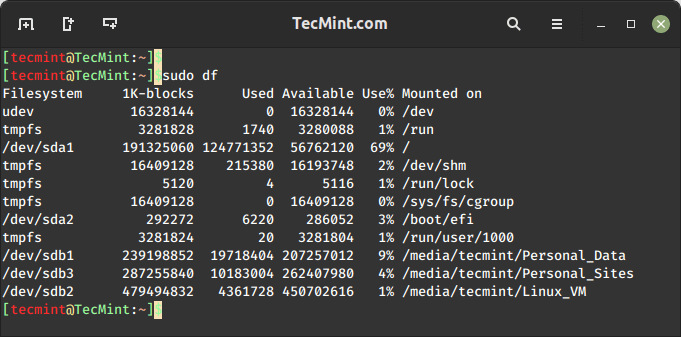
This is useful for scripting – raw block numbers are easier to parse programmatically. For daily sysadmin work, you’ll almost always want to add -h.
2. Show Disk Space in Human-Readable Format (The One You’ll Use Most)
The -h flag converts bytes into KB, MB, GB, or TB automatically – whichever unit makes the most sense for the size involved.
df -h
Sample output:
Filesystem      Size  Used Avail Use% Mounted on
tmpfs           3.2G  2.6M  3.2G   1% /run
/dev/sda1       696G  321G  339G  49% /
tmpfs            16G  861M   15G   6% /dev/shm
tmpfs           5.0M   12K  5.0M   1% /run/lock
efivarfs        256K   49K  203K  20% /sys/firmware/efi/efivars
tmpfs            16G     0   16G   0% /run/qemu
/dev/sda2       286M  6.2M  280M   3% /boot/efi
tmpfs           3.2G  156K  3.2G   1% /run/user/1000
/dev/sdb3       274G  2.9G  258G   2% /media/ravi/Personal_Sites
/dev/sdb1       229G  211G  6.0G  98% /media/ravi/Personal_Data
/dev/sdb2       458G   74G  361G  17% /media/ravi/Linux_VM
Pro Tip: Any time Use% is above 85%, treat it as a warning sign and investigate. At 95%+, you may start seeing application errors, failed writes, and corrupted log files.
3. Show All Filesystems Including Pseudo Filesystems
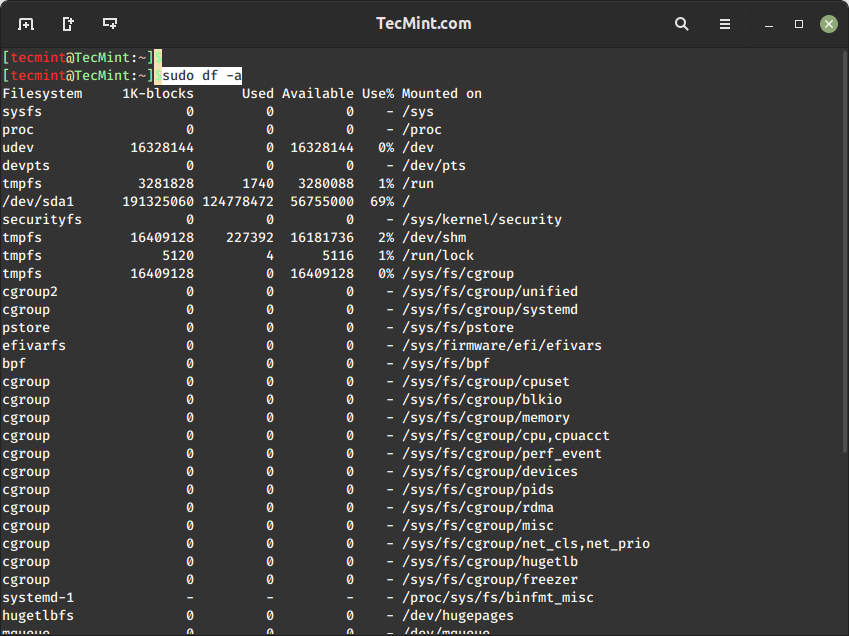
The command "df -a" is used to display information about all the mounted filesystems disk space usage, which includes total space, used space, available space, memory utilization, and the percentage of space used for each filesystem.
It also shows pseudo filesystems like tmpfs, sysfs, proc, and devtmpfs – which normally show 0 blocks and are hidden by default.
You’ll typically use this when debugging container environments, chroot setups, or systemd mount unit issues where a pseudo-filesystem mount isn’t behaving as expected.
df -a
4. Show Filesystem Type Alongside Disk Usage
Combining -T (type) and -h (human-readable) in one shot gives you a much more useful overview than running either alone, which is particularly helpful when you’re managing servers with a mix of ext4, xfs, and btrfs filesystems and need to know which tools to use for resizing or repair.
df -Th
Sample output:
Filesystem     Type      Size  Used Avail Use% Mounted on
tmpfs          tmpfs     3.2G  2.6M  3.2G   1% /run
/dev/sda1      ext4      696G  321G  339G  49% /
tmpfs          tmpfs      16G  869M   15G   6% /dev/shm
tmpfs          tmpfs     5.0M   12K  5.0M   1% /run/lock
efivarfs       efivarfs  256K   49K  203K  20% /sys/firmware/efi/efivars
tmpfs          tmpfs      16G     0   16G   0% /run/qemu
/dev/sda2      vfat      286M  6.2M  280M   3% /boot/efi
tmpfs          tmpfs     3.2G  160K  3.2G   1% /run/user/1000
/dev/sdb3      ext4      274G  2.9G  258G   2% /media/ravi/Personal_Sites
/dev/sdb1      ext4      229G  211G  6.0G  98% /media/ravi/Personal_Data
/dev/sdb2      ext4      458G   74G  361G  17% /media/ravi/Linux_VM
5. Check Disk Space for a Specific Directory or Partition
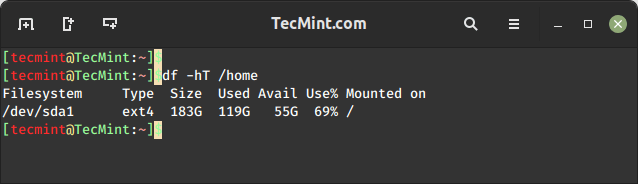
The command "df -hT /home" is used to display disk space utilization of /home directory or partition in a human-readable format. The -T option shows the filesystem type (ext4) along with other information.
df -hT /home
Or check multiple at once:
df -h / /home /var
6. Check Disk Space Usage in Kilobytes
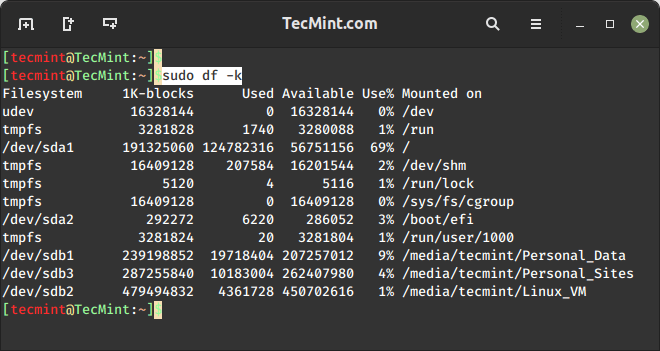
To display all mounted filesystem information and usage in 1024-byte blocks, use the option ‘-k‘ (e.g. --block-size=1K), which provides information about each filesystem on your system, presenting sizes in kilobytes (kb).
sudo df -k
7. Check Disk Space Usage in Megabytes
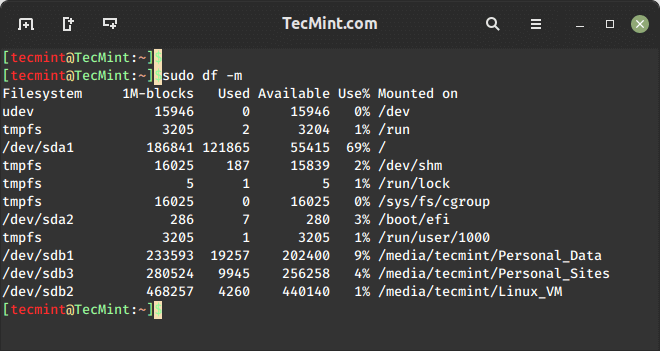
To display information on all file system usage in MB (MegaByte) use the option ‘-m‘, which presents sizes in megabytes (MB).
sudo df -m
8. Check Disk Space Usage in Gigabyte
The -B flag lets you specify an explicit block size. -BG forces gigabyte units, -BM forces megabytes, and -BK forces kilobytes – giving you predictable, fixed-unit output for scripts and reports rather than the auto-scaling behavior of -h.
sudo df -BG
Sample output:
Filesystem     1G-blocks  Used Available Use% Mounted on
tmpfs                 4G    1G        4G   1% /run
/dev/sda1           696G  321G      339G  49% /
tmpfs                16G    1G       15G   6% /dev/shm
tmpfs                 1G    1G        1G   1% /run/lock
efivarfs              1G    1G        1G  20% /sys/firmware/efi/efivars
tmpfs                16G    0G       16G   0% /run/qemu
/dev/sda2             1G    1G        1G   3% /boot/efi
tmpfs                 4G    1G        4G   1% /run/user/1000
/dev/sdb3           274G    3G      258G   2% /media/ravi/Personal_Sites
/dev/sdb1           229G  211G        6G  98% /media/ravi/Personal_Data
/dev/sdb2           458G   74G      361G  17% /media/ravi/Linux_VM
Note: df -h and df -BG are not the same. -h auto-selects the most readable unit per filesystem (so a 500MB partition shows in MB, not GB). -BG forces GB across the board, which means small filesystems show as 0G.
9. Check Inode Usage in Linux
Inodes are what Linux uses to track files and directories – not file contents, but the metadata (permissions, ownership, timestamps, pointers to data blocks). A filesystem can run out of inodes while still having plenty of disk space, which will cause No space left on device errors even though df -h shows free space available.
df -ih
Sample output:
Filesystem     Inodes IUsed IFree IUse% Mounted on
tmpfs            4.0M  1.3K  4.0M    1% /run
/dev/sda1         45M  1.6M   43M    4% /
tmpfs            4.0M  2.2K  4.0M    1% /dev/shm
tmpfs            4.0M     8  4.0M    1% /run/lock
efivarfs            0     0     0     - /sys/firmware/efi/efivars
tmpfs            4.0M     1  4.0M    1% /run/qemu
/dev/sda2           0     0     0     - /boot/efi
tmpfs            801K   152  801K    1% /run/user/1000
/dev/sdb3         18M  9.5K   18M    1% /media/ravi/Personal_Sites
/dev/sdb1         15M   21K   15M    1% /media/ravi/Personal_Data
/dev/sdb2         30M  2.2K   30M    1% /media/ravi/Linux_VM
Warning: If IUse% is above 90%, you have an inode exhaustion problem, which is commonly happens on mail servers, web servers with many small cache files, or systems where a runaway process has created thousands of temp files.
10. Filter df Output to Show Only a Specific Filesystem Type
This shows disk usage only for ext4 filesystems, which is useful on systems with a mix of filesystem types when you want to focus on just one kind.
df -t ext4 -h
Sample Output:
Filesystem      Size  Used Avail Use% Mounted on
/dev/sda1       696G  321G  339G  49% /
/dev/sdb3       274G  2.9G  258G   2% /media/ravi/Personal_Sites
/dev/sdb1       229G  211G  6.0G  98% /media/ravi/Personal_Data
/dev/sdb2       458G   74G  361G  17% /media/ravi/Linux_VM
Similarly, to check only xfs filesystems:
df -t xfs -h
11. Check Linux File System Type
The -x option excludes the specified filesystem type from the output, which is handy for cleaning up df -h output on systems where tmpfs mounts (for /dev/shm, /run, etc.) clutter the display and aren’t relevant to what you’re checking.
df -x tmpfs -h
Sample Output:
Filesystem      Size  Used Avail Use% Mounted on
/dev/sda1       696G  321G  339G  49% /
efivarfs        256K   49K  203K  20% /sys/firmware/efi/efivars
/dev/sda2       286M  6.2M  280M   3% /boot/efi
/dev/sdb3       274G  2.9G  258G   2% /media/ravi/Personal_Sites
/dev/sdb1       229G  211G  6.0G  98% /media/ravi/Personal_Data
/dev/sdb2       458G   74G  361G  17% /media/ravi/Linux_VM
12. Show Custom Output Columns
The --output option lets you specify exactly which columns appear and in what order, which is particularly useful in scripts and monitoring tools where you need a specific column layout. Available fields include: source, fstype, itotal, iused, iavail, ipcent, size, used, avail, pcent, file, and target.
df -h --output=source,fstype,size,used,avail,pcent,target
Sample Output:
Filesystem     Type      Size  Used Avail Use% Mounted on
tmpfs          tmpfs     3.2G  2.9M  3.2G   1% /run
/dev/sda1      ext4      696G  321G  339G  49% /
tmpfs          tmpfs      16G  859M   15G   6% /dev/shm
tmpfs          tmpfs     5.0M   12K  5.0M   1% /run/lock
efivarfs       efivarfs  256K   49K  203K  20% /sys/firmware/efi/efivars
tmpfs          tmpfs      16G     0   16G   0% /run/qemu
/dev/sda2      vfat      286M  6.2M  280M   3% /boot/efi
tmpfs          tmpfs     3.2G  164K  3.2G   1% /run/user/1000
/dev/sdb3      ext4      274G  2.9G  258G   2% /media/ravi/Personal_Sites
/dev/sdb1      ext4      229G  211G  6.0G  98% /media/ravi/Personal_Data
/dev/sdb2      ext4      458G   74G  361G  17% /media/ravi/Linux_VM
13. Monitor Disk Space in Real Time
The watch command re-runs df -h every 5 seconds and highlights changes. Use this when you’re running a large file copy, database dump, or log-generating operation and want to see disk space change in real time without manually re-running the command.
watch -n 5 df -h
Sample Output:
Every 5.0s: df -h                                                                                                                                                                   tecmint: Tue Mar 31 12:04:11 2026

Filesystem      Size  Used Avail Use% Mounted on
tmpfs           3.2G  2.9M  3.2G   1% /run
/dev/sda1       696G  321G  339G  49% /
tmpfs            16G  872M   15G   6% /dev/shm
tmpfs           5.0M   12K  5.0M   1% /run/lock
efivarfs        256K   49K  203K  20% /sys/firmware/efi/efivars
tmpfs            16G     0   16G   0% /run/qemu
/dev/sda2       286M  6.2M  280M   3% /boot/efi
tmpfs           3.2G  164K  3.2G   1% /run/user/1000
/dev/sdb3       274G  2.9G  258G   2% /media/ravi/Personal_Sites
/dev/sdb1       229G  211G  6.0G  98% /media/ravi/Personal_Data
/dev/sdb2       458G   74G  361G  17% /media/ravi/Linux_VM
14. Sort df Output by Usage Percentage
This pipes df -h output through sort, ordering results by the Use% column (field 5) in reverse numeric order – so the most full filesystems appear at the top. This is the quickest way to spot which partition needs attention on a server with many mounts.
df -h | sort -k5 -rn
Sample Output:
/dev/sdb1       229G  211G  6.0G  98% /media/ravi/Personal_Data
/dev/sda1       696G  321G  339G  49% /
efivarfs        256K   49K  203K  20% /sys/firmware/efi/efivars
/dev/sdb2       458G   74G  361G  17% /media/ravi/Linux_VM
tmpfs            16G  862M   15G   6% /dev/shm
/dev/sda2       286M  6.2M  280M   3% /boot/efi
/dev/sdb3       274G  2.9G  258G   2% /media/ravi/Personal_Sites
tmpfs           5.0M   12K  5.0M   1% /run/lock
tmpfs           3.2G  2.9M  3.2G   1% /run
tmpfs           3.2G  164K  3.2G   1% /run/user/1000
tmpfs            16G     0   16G   0% /run/qemu
Filesystem      Size  Used Avail Use% Mounted on
Pro Tip: Add this as an alias in your ~/.bashrc for quick daily checks:
alias dfs='df -h | sort -k5 -rn'
15. Check df Command Options
Prints all available options with brief descriptions. Use man df for the full manual.
df --help
Sample Output:
Usage: df [OPTION]... [FILE]...
Show information about the file system on which each FILE resides,
or all file systems by default.

Mandatory arguments to long options are mandatory for short options too.
  -a, --all             include pseudo, duplicate, inaccessible file systems
  -B, --block-size=SIZE  scale sizes by SIZE before printing them; e.g.,
                           '-BM' prints sizes in units of 1,048,576 bytes;
                           see SIZE format below
  -h, --human-readable  print sizes in powers of 1024 (e.g., 1023M)
  -H, --si              print sizes in powers of 1000 (e.g., 1.1G)
  -i, --inodes          list inode information instead of block usage
  -k                    like --block-size=1K
  -l, --local           limit listing to local file systems
...
Reading df Output: Practical Scenarios
Here are the scenarios that actually happen in production.
Scenario 1: Disk full but you can’t find what’s filling it
df -h shows /var at 99%, but du -sh /var/* shows only 10GB used. This classic mismatch usually means a deleted file is still held open by a running process — the space won’t be freed until that process closes or restarts.
# Find processes holding deleted files open
lsof +L1 | grep /var
Restart the relevant service and the space will free up immediately.
Scenario 2: Application throwing “No space left on device” but df shows free space
Check inodes first:
df -ih /var
If IUse% is at or near 100%, you’ve hit inode exhaustion. Common culprits: mail queues, PHP session files, or container overlay layers.
Scenario 3: Monitoring disk usage in a cron job
This script checks all mounted filesystems and sends an alert email when any partition crosses 85% usage.
#!/bin/bash
THRESHOLD=85
df -h --output=pcent,target | tail -n +2 | while read PCT MNT; do
    NUM=${PCT%%%}
    if [ "$NUM" -ge "$THRESHOLD" ]; then
        echo "WARNING: $MNT is at $PCT" | mail -s "Disk Alert: $MNT" [email protected]
    fi
done
df vs du – Which One Should You Use?
A common point of confusion:
| Aspect | df | du |
|---|---|---|
| What it reports | Free/used space on a mounted filesystem | Disk space consumed by specific files and directories |
| Speed | Instant — reads filesystem metadata | Slower — walks the directory tree |
| Use case | “Is this partition full?” | “What is filling up this partition?” |
Use df first to identify which partition is the problem, then use du command to drill down into what is causing it.
Quick Reference: Most Useful df Commands
| Command | Description |
|---|---|
df -h |
Human-readable overview of all filesystems |
df -Th |
Include filesystem type |
df -ih |
Check inode usage |
df -h /var |
Check a specific partition |
df -t ext4 -h |
Show only ext4 filesystems |
df -x tmpfs -h |
Exclude tmpfs from output |
df -h | sort -k5 -rn |
Sort by usage percentage (busiest first) |
watch -n 5 df -h |
Live monitoring every 5 seconds |
df -BG |
Force gigabyte units |
df -h --output=source,size,used,avail,pcent,target |
Display custom output columns |
Conclusion
The df command is straightforward, but most guides stop at the basic flags. In practice, knowing how to combine options, interpret edge cases like inode exhaustion, and automate alerts is what separates reactive disk management from proactive server administration.
If your immediate problem is a full disk and you need to find what’s eating space, pair df -h with du -sh /* | sort -rh | head -20 to quickly identify the largest directories.
For related disk management tools, see:
You might also like:



I also use
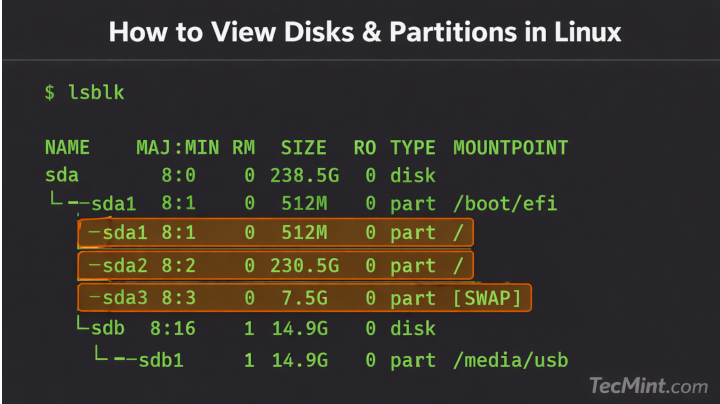
lsblkto list the sizes of the available partitions and to spot all those disk-hogging snaps.The ‘df‘ command stands for “disk filesystem”
This is incorrect. ‘df‘ stands for “disk free“.
@Benjamin,
The command ‘df’ stands for disk free – see – https://en.wikipedia.org/wiki/Df_(Unix)
To display information of all file system statistics in GB (Gigabyte) use the option as
‘df -g‘;)Hello all,
I am a newbie to Linux. I am using CentOS 7 in VMWare.
I tried
df -th xfsand got an error asBut when i reversed the flags and did ‘df -ht xfs‘, I got the proper output.
So my question is that do we have an overriding concept when it comes to flags as I was confused that why in it showed no such file error with
-th?option?A person’s success does not depend on his wisdom, but perseverance.
I still don’t know how much disk space i have left.
@Paolo,
The
df -hTwill display the size of all partitions table, there you can easily trace how much space utilized and left on each partition.use du not df or better ncdu.
df actually stands for: Disk free
from wikipedia: https://en.wikipedia.org/wiki/Df_(Unix)
Achtually, if you want to be super correct
df -hshows usage in Gibibytes,df -Hshows Gigabytes. The difference gets noticeable at high amounts and people are more used to thinking in Giga rather than Gibi no matter how much computer techs would prefer it to be the other way around.You have put the details other way around
-huses 1024 where as-Huses powers of 1000.-Hnumbers would be significantly higher than-h.I don’t see I left any details on which one is bigger in my original comment. People do get confused when you tell them they have fewer GiB (1024) than they expected since they are used to the smaller GB (1000).
And here in lies the problem with this nonsense called gibibytes etc.
I am a computer tech and no other computer techs I know (under the age of 30), give this ridiculous notion of a megabyte being 1000×1000 any time of day.
Sorry but a megabyte WILL ALWAYS be 1024 kilobytes (1024 bytes) x 1024 kilobytes no matter how hard the push is to rename computing standards to fall in line with other standards of measurements i.e kilogram, kilometre etc
It’s a real pity that in Linux you can’t show file sizes in traditional/correct megabytes, gigabytes etc
I see Gibibyte and I think Gigabyte. THAT and mass confusion is all this nonsense has achieved.
I meant to say ‘over the age of 30’ ;)
How can I check the space utilized by me in unix? Also how to check the size of the files by descending order?
@Vicky,
There are number of ways you can get the disk space utilization in Linux, the one using df command a shown in this article, other alternative ways to get the space usage in Linux using:
9 Tools to Watch Disk Space Size in Linux
Find Top Directories and Files Disk Space Usage
how to check diskspace in particular filesystem or drive
@Shankar,
Use df command to check the disk space usage of any filesystem..
Thanks for the article, very useful…
how to find out the disk space of all servers
@Nikitha,
Better Install Nagios Monitoring Application to monitor all Linux Servers disk place at one console..
Why is “df -hT /home” giving me the same exact results as “df -hT /” ?
“/” should be the root folder and “/home” should be a directory underneath root (“/”) but I am getting the same exact results down to the byte level.
In any case, decided to use “df -h –type=ext4” so that I can be sure I can see the entire space available to me. The other filesystems are for the system to manage directly (ex: udev, tempfs and none). “none” is referring to /sys/fs/cgroup and a couple of /run/* directories.
@Jamesh,
The df command used to display disk usage of File system, not a directory, here
/homenot a filesystem or partition, that’s the reason its showing/usage..3 and 7 are duplicates! Only 11 useful commands
Indeed and #7 is just downright wrong. “Displays in GB”. It displays in whatever unit it deems best, it will show TB or MB too. Even the example they have demonstrating #7 shows two filesystems/mount-points in MB!
I have a file system that is not a Mount Point and does not show up when “df” is executed….. Is there a command to show the file allocation and utilization for a file system that is allocated space, but, is not configured as a Mount Point?
Thanks,
Andy
@Andy,
In this case you should use du command to find out disk usage of files and directories in Linux..
Hi Ravi,
According to Andy he said the file system is not on a mount point.
to access any filesystem it should be mounted right.
If its only about allocation u can use fdisk or parted if its a physical partition / lvs or lvscan if if its a LVM one.
thanks
Mohideen
very useful and well explained “df” commands, Thanks !!
Very useful, thank you, ones of the most used commands Leo Podstanicky
Thank you for the article. I was able to find the size of my home directory using one of the commands.
hi, I want to free space in /uo2/Oracle/Middleware how do i do that
@Tony,
Delete unwanted files, that’s it to free up some space using rm command
there are 11 you use df -h twice (7) and (3)
very useful and very easy way to learn the linux
Well -k is not in bytes.
I used man df for help.. and I am not sure how to exit from help. I tried esc button, It shows end. Can you help me to exit from the help menu. Ofcourse for how close the terminal.
@Satish,
Just press ‘q‘ keystroke to exist from the man pages in the linux from the commandline. I hope it will resolve your issue and keep connected to tecmint for such awesome articles..
Thx, this saved me a lot of work and helped me to solve some problems. I’ll save this article to my bookmarks, you always need all kind of linux commands.
very nice information.
Thank you
Thanks Ravi for explaining in detail. I being a newbie was lil worried using the Linux Commands. The explanation really helped free 15 GB of data on my server. Cheers !
If your df differs from du -csm /mountpoint, check for deleted files still opened (so still on disk, seen by df, but not du) with lsof :
lsof |grep deleted
For an online disk usage report you can also try http://www.diskreport.net
With periodic reports you can get graphs of size changes for each directory, very usefull to find growing files
Very useful. Thanks.
Thanks so much Ravi!
Just a note — #5 shows “in bytes”.. it really should say “in kilobytes”. If you want to show the filesystem size in bytes, you need to set the blocksize to 1 (not 1K).
I’m working on a project now where they want the filesystem size in bytes, and I was surprised to see that ‘df’ doesn’t natively support that.
Hi, I came across this script (http://www.systemtoolbox.com/article.php?articles_id=1023)for iterating through a server list file and mapping each of the server drives indicated and takes a snapshot of the df information and appends it to a file named relative to server and drive letter.
However, it seems the script is not working or complete. I would appreciate if someone can help explain to me hoe to use it. I am looking for the destination of the text file created and appended with the server and drive information. Thanks.
for /f “tokens=1,2 delims= ” %%A in (drives.lst) do (
echo %%A %%B
net use x: /del temp.txt
type temp.txt | cut -f2 -d: | cut -f2 -dG > temp2.txt
for /f %%Q in (temp2.txt) do (
echo %%Q >> %%A-%%B.txt
)
del temp.txt
del temp2.txt
)
Hallo ravi,
I have one question that how we can check disk only free or only occupied free space of disk and then make if condition like
If(Free space == 20% ) then
do this action
else
null
fi
Wow, thanks a lot! This helped me out a lot but I couldn’t find out how to see how much disk space a certain directory is using. I tried “df -hT /var/www/vhosts/domain” but it didn’t show me. :( But other than that this article has helped me a lot. Thank you!
A directory is not the same thing as a filesystem. ‘df’ shows filesystem information. The directory /var/www/vhosts/domain is likely a directory on the /var filesystem, so issuing a ‘df’ there will show you stats for /var. If you want disk usage for a particular directory, use the ‘du’ command. The man page should give you the information you need.
Our vendor has finished installing redhat OS on our servers & has submitted a machine installation report. When I verify the file system using df -h , the sum of the size of the file systems as shown in the output is greater than the actual HDD size allocated to that virtual machine. But when I use fdisk -l|grep Disk, the size shown in output matches with the hdd size. Can you please help me out as to how do I verify the file system ??
My aim is to match the HDD size allocated to particular Virtual machine with the total size all file systems on that VM.
watch df -h for keeping an eye on active disk growth or shrink if you are running batches.
very clear,good article,thanks for sharing
df -P is usefull too