Skip to content
Learn Linux in 7 structured days, the free course inside Pro TecMint Sudo tier    Enroll Free
Tecmint: Linux Howtos, Tutorials & Guides
  • Latest Tutorials
  • Commands
    • A – Z Linux Commands
    • 100+ Linux Commands
  • Tools
  • Distros
    • Linux Distros for Beginners
    • Linux Distros for Experts
    • New Linux Distros
    • Linux Server Distros
    • Secure Linux Distros
    • CentOS Alternatives
    • RedHat Distributions
    • Debian Distributions
    • Ubuntu Distributions
    • Arch Linux Distros
    • Rolling Linux Distros
    • KDE Linux Distros
    • Linux Distros for Old PC
    • Linux Distros for Kids
    • Linux Distributions for Students
    • Linux Distros for Windows
  • Courses
    • Bash Scripting
    • Learn Linux
    • AI for Linux
    • RHCSA Certification
    • RHCE Certification
    • LFCS Certification
  • eBooks
    • RHCSA Exam
    • RHCE Exam
    • LFCS Exam
    • LFCE Exam
    • LFCA Exam
    • Ansible Exam
  • About
  • Advertise
Tecmint: Linux Howtos, Tutorials & Guides
  • Latest Tutorials
  • Commands
    • A – Z Linux Commands
    • 100+ Linux Commands
  • Tools
  • Distros
    • Linux Distros for Beginners
    • Linux Distros for Experts
    • New Linux Distros
    • Linux Server Distros
    • Secure Linux Distros
    • CentOS Alternatives
    • RedHat Distributions
    • Debian Distributions
    • Ubuntu Distributions
    • Arch Linux Distros
    • Rolling Linux Distros
    • KDE Linux Distros
    • Linux Distros for Old PC
    • Linux Distros for Kids
    • Linux Distributions for Students
    • Linux Distros for Windows
  • Courses
    • Bash Scripting
    • Learn Linux
    • AI for Linux
    • RHCSA Certification
    • RHCE Certification
    • LFCS Certification
  • eBooks
    • RHCSA Exam
    • RHCE Exam
    • LFCS Exam
    • LFCE Exam
    • LFCA Exam
    • Ansible Exam
  • About
  • Advertise

History Commands

Run Last Executed Commands in Linux

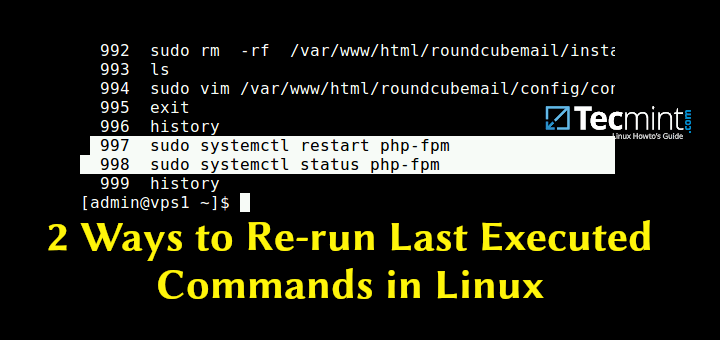
2 Ways to Re-run Last Executed Commands in Linux

One of the greatest features of Bash is the command history, which stores all commands a user runs, in a

TecMint Weekly
Get the Learn Linux 7 Days Crash Course free when you join 34,000+ Linux professionals reading every Thursday.
Check your email for a magic link to get started.
Something went wrong. Please try again.
Free forever. Unsubscribe anytime.
Learn Linux Right Way
15 structured courses, ad-free articles, and the weekly newsletter in one place.
  • ✓SSH, Bash, Ubuntu, Golang, RHCSA, RHCE, LFCS, LFCA and more
  • ✓Ad-free access to all premium articles
  • ✓Priority help and Telegram community
  • ✓Weekly newsletter every Thursday
Join Root from $8/mo
$8/mo or $59/yr. Cancel anytime.

Linux Server Monitoring Tools

How to Automate Daily Linux Health Checks with a Bash Script + Cron

Cockpit – A Powerful Tool to Monitor and Administer Multiple Linux Servers via Browser

3 Methods to Check Apache Server Status and Uptime in Linux

How to Monitor Linux Server and Process Metrics from Browser

Hardinfo2 – Check Hardware Information in Linux

Install Glances, InfluxDB and Grafana to Monitor CentOS 7

Learn Linux Tricks & Tips

13 Linux Network Configuration and Troubleshooting Commands

20 mysqladmin Commands for MYSQL/MariaDB Database Administration

2 Ways to Create an ISO from a Bootable USB in Linux

How to Enable Syntax Highlighting in Vi/Vim Editor

8 Linux Nslookup Commands to Troubleshoot DNS (Domain Name Server)

How to Encrypt and Decrypt Files and Directories Using Tar and OpenSSL

Best Linux Tools

7 Best Skype Alternatives for Linux in 2025

My Favorite Command Line Editors for Linux – What’s Your Editor?

21 Best Slack Alternatives for Team Chat [Free & Paid]

15 Best Kali Linux Web Penetration Testing Tools

16 Free and Open Source Video Players for Linux in 2024

6 Best Modern Linux ‘init’ Systems (1992-2025)

Tecmint: Linux Howtos, Tutorials & Guides © 2026. All Rights Reserved.

The material in this site cannot be republished either online or offline, without our permission.

Hosting Sponsored by : Linode Cloud Hosting