

Whether you are learning your first printf() program or building large C/C++ projects, choosing the right IDE can save you a lot of time and some tools focus on simplicity for beginners, while others offer advanced debugging, Git integration, and powerful code analysis for professional development.
In this list, you’ll find several lightweight editors, full-featured IDEs, and modern AI-powered coding environments that make writing C and C++ on Linux easier and faster.
What is an IDE?
An IDE (Integrated Development Environment) editor is a software application that offers an extensive collection of tools for software development, which includes a text editor, debugging tools, a code compiler, version control, and other features that help software developers to write, debug, and test their code efficiently.
A text editor is generally an IDE but designed to offer a more feature-rich environment that includes syntax highlighting, code folding, auto-indentation, and code completion, which is a useful feature that helps developers to reduce code errors and write code more efficiently.
nano for everything.1. NetBeans for C/C++ Development
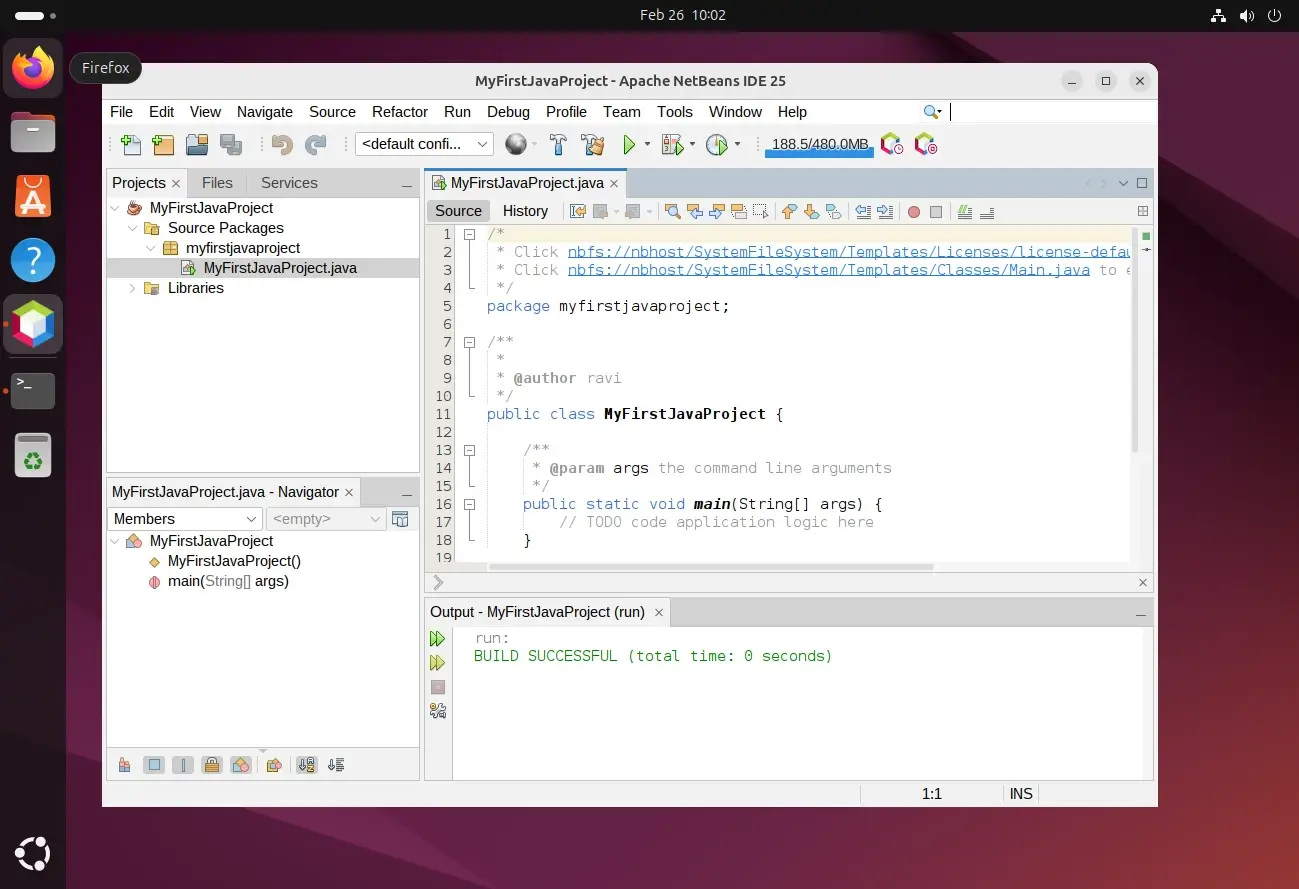
NetBeans is a free, open-source, cross-platform IDE maintained under the Apache project. It has solid C/C++ support with project templates, static and dynamic library builds, and the ability to reuse existing code across projects.
The C/C++ editor integrates with the multi-session GNU GDB debugger, supports code assistance and C++11, and lets you create and run tests from inside the IDE.
It handles multiple compilers, including GNU, Clang/LLVM, Cygwin, Oracle Solaris Studio, and MinGW.
Remote development, file navigation, source inspection, Qt toolkit support, and automatic packaging into .tar, .zip, and other archive formats round out a complete environment.
2. Code::Blocks
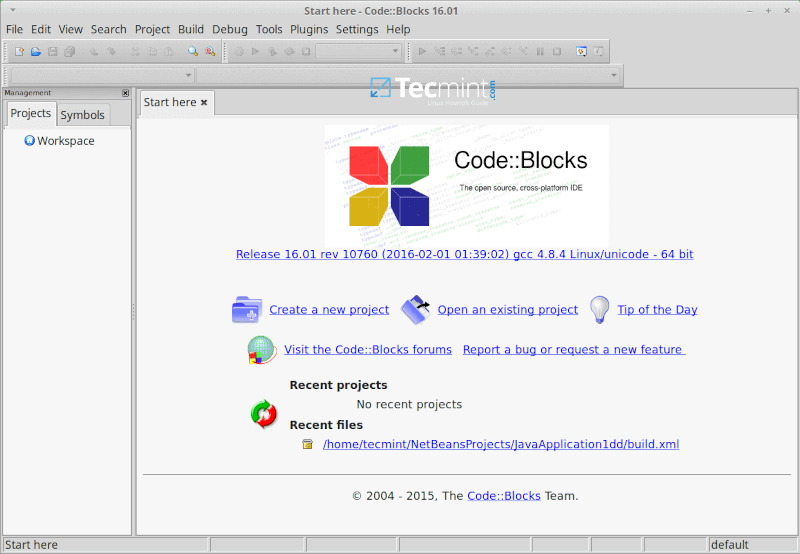
Code::Blocks is a free, highly extensible, configurable, cross-platform C++ IDE built to offer users the most demanded and ideal features. It delivers a consistent user interface and feel.
And most importantly, you can extend its functionality by using plugins developed by users; some of the plugins are part of the Code::Blocks release, and many are not, written by individual users not part of the Code::Blocks development team.
Its features are categorized into a compiler, debugger, and interface features, and these include:
- Multiple compiler support, including GCC, clang, Borland C++ 5.5, Digital Mars, plus many more
- Very fast, no need for makefiles
- Multi-target projects
- A workspace that supports the combining of projects
- Interfaces GNU GDB
- Support for full breakpoints, including code breakpoints, data breakpoints, breakpoint conditions, plus many more
display local functions, symbols, and arguments - custom memory dump and syntax highlighting
- Customizable and extensible interface, plus many other features, including those added through user-built plugins
printf statements to track bugs.3. Eclipse CDT(C/C++ Development Tooling)
Eclipse is a well-known open-source, cross-platform IDE in the programming arena. It offers users a great GUI with support for drag and drop functionality for easy arrangement of interface elements.
The Eclipse CDT is a project based on the primary Eclipse platform, and it provides a fully functional C/C++ IDE with the following features:
- Supports project creation.
- Managed builds for various toolchains.
- Standard make build.
- Source navigation.
- Several knowledge tools, such as the call graph, type hierarchy, built-in browser, and macro definition browser.
- Code editor with support for syntax highlighting.
- Support for folding and hyperlink navigation.
- Source code refactoring plus code generation.
- Tools for visual debugging, such as memory and registers.
- Disassembly viewers and many more.

4. CodeLite IDE
CodeLite is also a free, open-source, cross-platform IDE designed and built specifically for C/C++, JavaScript (Node.js), and PHP programming.
Some of its main features include:
- Code completion offers two code completion engines.
- Supports several compilers, including GCC, clang/VC++.
- Displays errors as a code glossary.
- Clickable errors via the build tab.
- Support for LLDB next-generation debugger.
- GDB support.
- Support for refactoring.
- Code navigation.
- Remote development using built-in SFTP.
- Source control plugins.
- RAD (Rapid Application Development) tool for developing wxWidgets-based apps, plus many more features.

5. Bluefish Editor
Bluefish sits somewhere between a text editor and a full IDE – lightweight and fast, but with enough features to handle real development work. It runs on Linux, Mac OSX, FreeBSD, OpenBSD, Solaris, and Windows, and supports C/C++ among many other languages.
Key features include multiple document interfaces, recursive file opening based on filename or content patterns, a powerful search and replace, a snippet sidebar, and full-screen editing.
The site uploader and downloader make it useful for web work too. For developers who want something between Vim and Eclipse without the weight of a JVM-backed IDE, Bluefish fills that gap cleanly.

6. Sublime Text Editor
Sublime Text is a multi-platform editor built for code, markup, and prose. Version 4 is current and actively maintained. It handles C/C++ well and is consistently fast, especially on large files where heavier editors start to lag.
Feature highlights: multiple selections, a command palette, Goto Anything navigation, distraction-free mode, split editing, instant project switching, and a Python-based plugin API.
It’s not a full IDE out of the box, but with the right plugins, it gets close enough for most C/C++ work.

7. JetBrains CLion
CLion is a non-free, powerful, and cross-platform IDE for C/C++ programming. It is a fully integrated C/C++ development environment for programmers, providing Cmake as a project model, an embedded terminal window, and a keyboard-oriented approach to code writing.
It also offers a smart and modern code editor, plus many more exciting features to enable an ideal code-writing environment, and these features include:
- Supports several languages other than C/C++
- Easy navigation to symbol declarations or context usage
- Code generation and refactoring
- Editor customization
- On-the-fly code analysis
- An integrated code debugger
- Supports Git, Subversion, Mercurial, CVS, Perforce(via plugin), and TFS
- Seamlessly integrates with Google test frameworks
- Support for Vim text editor via Vim-emulation plugin

8. Visual Studio Code
Visual Studio is a rich, fully integrated, cross-platform development environment that runs on Linux, Windows, and Mac OS X. It was recently made open-source to Linux users, and it has redefined code editing, offering users every tool needed for building every app for multiple platforms, including Windows, Android, iOS, and the web.
It is feature-full, with features categorized under application development, application lifecycle management, and extending and integrating features. You can read a comprehensive list of features on the Visual Studio website.

9. KDevelop
KDevelop is a free, open-source, cross-platform IDE that works on Linux, Solaris, FreeBSD, Windows, Mac OSX, and other Unix-like systems. It’s built on KDevPlatform, KDE, and Qt libraries and is extensible through plugins.
It includes a Clang-based C/C++ plugin, support for Grep view, a uses widget for exploring symbol references across the codebase, and various line editing modes across views.
For developers already in a KDE environment, KDevelop integrates naturally with the desktop and tooling they’re already using.

10. Geany IDE
Geany is a fast, lightweight, cross-platform IDE that runs with minimal dependencies and doesn’t require GNOME or KDE libraries – just GTK2. That makes it a reliable choice on minimal Linux installs, older hardware, or anywhere you want an IDE that starts instantly.
It covers the basics well: syntax highlighting, code folding, call tips, symbol name auto-completion, symbol lists, and code navigation. The built-in compile-and-run system means you can go from a new file to running code without any project setup. Plugin support adds functionality without bloat.

11. 11. GNOME Builder
GNOME Builder is the official IDE for GNOME platform development, replacing Anjuta DevStudio. It’s free, open-source, and actively maintained.
It’s designed primarily for building GNOME applications in C, though it supports other languages and project types. Flatpak integration is built in, which makes building and testing packages against the GNOME runtime straightforward.
For any work on the GNOME desktop or GTK applications, GNOME Builder is the right tool. It’s not a general-purpose C/C++ IDE for all projects, but for its target use case, it’s the best option available.

12. The GNAT Programming Studio
The GNAT Studio (previously GPS) is a free IDE developed by AdaCore for Ada and C/C++ development. It’s designed around source navigation and code comprehension rather than feature volume.
It provides a multi-lingual, multi-platform environment with a flexible MDI, customizable interface, and full extensibility through plugins. It’s a niche tool – most useful if you’re working on Ada projects that include C/C++ components – but it’s free and actively maintained by AdaCore.

13. Qt Creator
Qt Creator is a free, cross-platform IDE built specifically for applications using the Qt framework. It’s the natural choice for C++ GUI development, embedded systems work, or building apps that need to run on multiple platforms from a single codebase.
Features include a sophisticated code editor, version control integration, project and build management tools, and multi-platform switching. It supports mobile and desktop targets alongside connected embedded devices. Qt Creator is free for open-source projects; commercial use requires a Qt license.

14. Emacs Editor
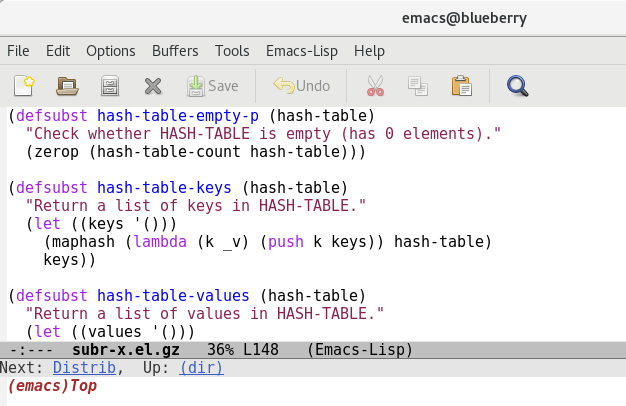
Emacs is a free, powerful, highly extensible, and customizable, cross-platform text editor you can use on Linux, Solaris, FreeBSD, NetBSD, OpenBSD, Windows, and Mac OS X.
The core of Emacs is also an interpreter for Emacs Lisp, which is a language under the Lisp programming language. As of this writing, the latest release of GNU Emacs is version 27.2, and the fundamental and notable features of Emacs include:
- Content-aware editing modes
- Full Unicode support
- Highly customizable using GUI or Emacs Lisp code
- A packaging system for downloading and installing extensions
- An ecosystem of functionalities beyond normal text editing, including a project planner, mail, calendar, and newsreader, plus many more
- A complete built-in documentation, plus user tutorials and many more
15. SlickEdit
SlickEdit (previously Visual SlickEdit) is an award-winning commercial cross-platform IDE created to enable programmers the ability to code on 7 platforms in 40+ languages. Respected for its feature-rich set of programming tools, SlickEdit allows users to code faster with complete control over their environment.
Its features include:
- Dynamic differencing using DIFFzilla
- Syntax expansion
- Code templates
- Autocomplete
- Custom typing shortcuts with aliases
- Functionality extensions using Slick-C macro language
- Customizable toolbars, mouse operations, menus, and key bindings
- Support for Perl, Python, XML, Ruby, COBOL, Groovy, etc.

16. Lazarus IDE
Lazarus IDE is a free and open-source Pascal-based cross-platform visual Integrated Development Environment created to provide programmers with a Free Pascal Compiler for rapid application development. It is free for building anything, including e.g. software, games, file browsers, graphics editing software, etc., irrespective of whether they will be free or commercial.
Feature highlights include:
- A graphical form designer
- 100% freedom because it is open source
- Drag & Drop support
- Contains 200+ components
- Support for several frameworks
- A built-in Delphi code converter
- A huge welcoming community of professionals, hobbyists, scientists, students, etc.

17. The Eric Python IDE
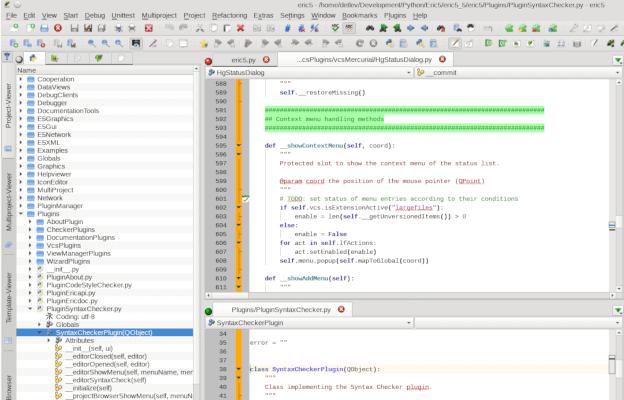
The Eric Python IDE is a full-featured Python IDE written in Python, based on the Qt UI toolkit, to integrate with the Scintilla editor control. It is designed for use by both beginner programmers and professional developers, and it contains a plugin system that enables users to easily extend its functionality.
Its feature highlights include:
- 100% free and open-source
- 2 tutorials for beginners – a Log Parser and Mini Browser application
- An integrated web browser
- A source documentation interface
- A wizard for Python regular expressions
- Graphic module diagram import
- A built-in icon editor, screenshot tool, and difference checker
- A plugin repository
- Code autocomplete, folding
- Configurable syntax highlighting and window layout
- Brace matching
18. MindForger
MindForger is a free, open-source Markdown IDE built as a smart note-taker, editor, and organizer. It’s privacy-focused and supports several encryption tools, including ecryptfs.
Features include automatic linking, HTML preview and zooming, import/export, tag support, metadata editing, sorting, and Git and SSH support. It’s a niche tool – more useful as a knowledge management system that also handles code than as a primary C/C++ IDE.
For developers who document heavily alongside their coding, it’s worth looking at.
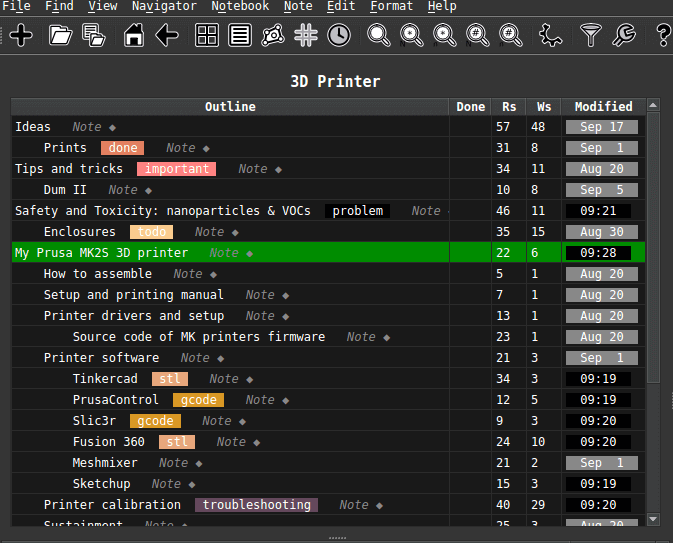
19. Zed
Zed is a high-performance, open-source code editor built in Rust by the team that previously built Atom and the Electron framework. It launched on Linux in 2024 and has become one of the most talked-about editors in developer communities since.
The performance is noticeably different from Electron-based editors – GPU-accelerated rendering, sub-1-second startup times, and significantly lower memory usage than VS Code.
Real-time collaborative editing is built in, not an add-on.
It has built-in AI features, LSP support for C/C++ via clangd, and a growing extension library that crossed 1,000 extensions in early 2026. For developers who want speed and a clean experience without giving up modern tooling, Zed is the strongest new option on this list.

20. Neovim
Neovim is a fork of Vim that modernized the internals while keeping everything that made Vim fast. It adds async plugin support, a Lua-based configuration system, and a built-in LSP client that gives you full IDE-level code intelligence with any language server – including clangd for C/C++.
Distributions like LazyVim and AstroNvim ship a preconfigured IDE-like experience you can adjust from there, which removes most of the initial setup pain. Neovim stays in the terminal, starts instantly, and handles large codebases without the memory overhead of Electron-based editors.
It remains one of the most popular environments for developers who want full control over their tooling.

21. Helix
Helix is a free, open-source terminal editor written in Rust that has been picking up serious attention in developer communities as a modern alternative to Vim and Neovim.
The key difference is what it ships with by default: built-in LSP support, Tree-sitter syntax highlighting, and multiple cursors work out of the box without any plugin setup or config files.
Unlike Vim or Emacs, you don’t need to spend hours wiring up plugins to get code completion, diagnostics, and accurate syntax highlighting for C/C++.
Point it at a project with clangd installed, and it just works. The editing model takes inspiration from Kakoune – you select first, then act, which keeps the current operation always visible on screen.
That’s a deliberate reversal of Vim’s grammar, and it takes some adjustment, but most developers find it clicks faster than expected. hx --tutor gets you up to speed in about 20 minutes.
It’s not a full IDE and doesn’t try to be, but for terminal-first developers who want Vim-style editing with none of the configuration overhead, Helix is the most practical option on this list.

22. VI/VIM Editor
Vim, an improved version of the VI editor, is a free, powerful, popular, and highly configurable text editor. It is built to enable efficient text editing and offers exciting editor features for Unix/Linux users; therefore, it is also a good option for writing and editing C/C++ code.
To learn how to use the Vim editor in Linux, read the following articles:
Conclusion
IDEs give you more programming comfort than plain text editors – debugger integration alone changes how fast you can fix a broken build. Every tool on this list works on Linux today and is actively maintained.
For lightweight C work on a minimal install, start with Geany or CodeLite. For professional C++ development, CLion or VS Code with the C/C++ extension are the strongest options.
For raw speed and modern AI features, Zed is the standout new addition. For terminal-only development, Neovim with clangd gives you IDE-level intelligence without leaving the command line and if you want that same terminal experience with zero configuration, Helix is worth trying first..
Try 2 or 3 from this list on your actual machine. The one that gets out of your way fastest is the right one. Which IDE are you currently using for C/C++ on Linux? Drop it in the comments below.

My choice is Codelobster IDE, you should check and must include it in the list…
I know it’s an old thread, but can I use Code::Blocks as a beginner in C++?
I suggest that you go to the Code::Blocks Website: https://wiki.codeblocks.org/index.php/Main_Page
And fully read the FAQ: https://wiki.codeblocks.org/index.php/FAQ
Along with the other information on the Code::Blocks site to answer all your questions.
Graviton link is wrong, here is the new one – https://graviton.netlify.app/
@Boeing,
Thanks, corrected the link in the article…
Why is Qt Creator described as non-free?
https://github.com/qt-creator/qt-creator.@spider-mario
Thanks for raising this concern, there is actually a paid-for version. But we will change the description to free and open source and point the link to the Github repository. Thanks once more.
Where is Komodo?
@tom-erik,
Thanks, added Komodo IDE to the list as suggested..
In all IDEs for C/C++ you show here, I used Netbeans, KDevelop, Code:: Blocks, Eclipse and Visual Studio Code.
The best hands down are Netbeans because is really powerful and more intuitive and consistent. KDevelop is some tied to QT, Code::Block and Visual Studio are some crude, but Eclipse for Linux is simply unusable.
I have been in this business since 1986, and have taught C & C++ on a University level, and well as a contract programmer.
IMHO, having used and experimented with various IDE’s, I have yet to find one I could use comfortably. I currently using a full featured programmers editor, emacs, which could be considered by some, as an IDE. I don’t, even though it should be on the list, to counter the inclusion of vi/vim,
IMHO, the best IDE is the Linux O/S, and bash command line! No, I am not kidding!
I use emacs as my editor, and to compile using a Makefile. (It does have a feature that allows me to locate and correct errors easily! Along with many other excellent features and add-ins.)
For debugging, I don’t use gdb directly, but I do use kdbg, as I find it easier to use than gdb directly.
There are other tools available, such as valgrind, splint, profilers, and others, that may or may not integrate with some IDE’s. Some external tools might integrate well with one or more IDE’s, and other external tools might only work with other IDE’s. All external tools WILL work well with the bash command prompt!
A lot of people, especially beginners, get caught up in figuring out how to configure and use IDE’s, and resort to online forums, when they fail, and can’t figure out how to fix whatever problem the are having! ;^) They spend more time fighting the IDE than writing the program itself!
My favorite misconception by beginners, is: “Code::Blocks is a compiler!” ;^) (See: http://wiki.codeblocks.org/index.php/FAQ-General#Q:_What_Code::Blocks_is_not.3F)
IMHO, when you eliminate the chaff (IDE’s) and concentrate on learning the language, editors, tools, libraries, etc…, you become a better programmer, faster, and more effectively.
Not trying to start a flame war but to offer the bash command line as a valid option to the IDE’s listed.
I’ve tried Code::Blocks and I am very displeased with it. The description here is incorrect. It lacks many IDE features, so what’s all about “offer users the most demanded and ideal features”? The GUI is not consistent at all and contains many bugs.
Furthermore, the syntax highlighting sucks, refactoring is something the devs have never heard of, and closed panels are not automatically opened when new output is generated (compile or console).
Following up on this months-old promise to update the article. As noted, your list is missing sequence #5. No biggie, just a glitch in the production process, I’m sure. To be more clear about the second point, the open-source version of Qt Creator is Free Software, licensed under the GPL v3. I know this is easy to miss, because the Qt web site pushes you to the commercial (closed-source) version. But the open source version is Free, and is available on Github.
@Mark,
Sorry for the delay, we will update this article by this weekend…
Hey. 14 is Anjuta, not Ajunta.
@Edson,
Thanks, corrected in the article.
Should add Jetbrain CLion to the list to, it is pretty good.
@Dung,
Thanks for notifying about Jetbrain CLion, we will add to this list..
It feel like the current list is very limited because of the type of developers creating the list.
I really suggest some pretty good IDE’s that exists for a long time.
like
– segger embedded studio
– intel parallel studio XE
– Crossworks
– Ninja IDE
– Coda
– emIDE.org
– MS visual studio IDE for MAC & Windows
Some of those are paid, and very expensive.
Almost none of those are C++ native IDE
@Maxence
Okay, give us the list of native C++ IDEs and we shall add them to this list. We will be grateful.
No mention of SlickEdit means this is not a professional list. It’s not free, but it’s totally worth it.
@Marc,
Thanks for telling about SlickEdit, we will add it to list..
Lazarus is a good one for Pascal development (with a built in interface designer), Monodevelop is another fairly complete one that probably deserves to be on this list.
Gambas is yet another good one, SPE (Stani’s Python Editor), Eric (another Python Editor) and Boa Constructor (a Python IDE) are other good ones for Python development as well.
This list is incorrect. #5 is missing and Qt Creator is not non-free.
@Incorrect
Okay, thanks for mentioning this, we will correct the article, as soon as possible.
Hello, can some one here suggest me the best IDE in which we can create GUI using python &
DO EMBEDDED CODING
Regarding the first sentence of this article.
C++ is not an extension to C. It is a different language. Although C++ started as an extension to C they are separate things today. For instance, one cannot say C++ is a super set of C.
I have no skill in programming yet, I’m still learning and so far? I have read article after article praising Vim or EMacs, which to me? NEITHER are very nice. The controls are too archaic and you need to actually memorize them in order to get anything done. And while that might be ok if you’re just a hobbyist, when you have deadlines, and meetings to attend it becomes a bit of a setback.
But I am learning that Atom and CodeBlocks are quite nice and usable, along with being user friendly, (which as a Linux user I shouldn’t even utter the words!….LoL!) but they are also not too greedy for resources, and just do what I need it to do…..I guess different strokes for different folks….great articles though!….Keep up the great work!!!
@Eddie
Thanks a lot for sharing your thoughts with us.
Thanks for reminding me of NetBeans! I was looking for a cross-platform and multi-platform IDE for working on embedded projects. This should enable me to sync between build machines (FreeFileSync) and build my projects for all my targets (about 12) on Windows, Mac, and Linux.
@Tom
Am glad that this guide helped you, thanks for the feedback.
gEdit is missing :)
@AlloSchool
Okay, thanks for mentioning, we will add it to the list.
You don’t mean gedit in Ubuntu, do you? That’s just a simple (and I mean SIMPLE) text editor.
Good work, thank you very much Aaron!
Also many thanks to Kris, mentioned Lazarus.
thanks very much
that was very helpful for me
@islam
Welcome, thanks for reading, and for appreciating this piece of work.
You are aware some. Thanks very much
@David
Welcome, thanks for reading and for the feedback.
I am sorry but one IDE is missing. And it is one that is far better than ANY of the ones mentioned. The Lazarus IDE. The only thing is that it is IDE not for C/C++/Java but for Object Pascal. But there currently is no other IDE that is better for creating and debugging GUI apps than Lazarus IDE.
It is exactly the same in every way as its Windows and MacOS flavor. Moreover, it also runs on ARM Linux, including single board computers like raspberry pi. You write your project code once, then you can compile the very exact same project source on any of these platforms in their versions of Lazarus.
And if you are using Linux on your desktop, then with wine you can have both Linux and Windows Lazarus IDE installed and from a single desktop natively compile native Windows and Linux apps without virtualization. None of these listed IDEs can compare, really.
@Kris
Many thanks for mentioning it, and for the clear description, we will check it out.
However I noticed, that in the title you mentioned explicitly that you list IDEs for C/C++, in which case it is ok to ignore Lazarus IDE.
My favorites are Vim, Codeblocks, Codelite and QtCreator, cause they are super lightweight!
I personally like QtCrrator due to its native for Qt Toolkit beside it’s ability to be used for plain c/c++. It support several license schemes, where it’s free if you chose LGPL open source scheme.
@Dedy
Thanks for sharing your thoughts.
Emacs was great when there were no alternatives. Now it’s really kind of an anachronistic toy in my opinion. Sure, it’s really powerful if you 1) want to take the time to learn its own little brand of lisp & 2) want to take the time to create modules for it.
Reminds me of a friend who LOVES the forth programming language. He’s now an IT admin who has no need of any programming language, but boy he loves that forth…
@tim
Many thanks for sharing your experience with us. I personally prefer Vi/Vim over Emacs and here are the reasons: 10 Reasons Why You Should Use Vi/Vim Text Editor in Linux
“visual studio” and “visual studio code” are different editors.
HomePage is hence wrong and should be: “https://code.visualstudio.com/”
@Raphael,
Yes, you correct, we’ve updated the homepage link for visual studio code editor.
I can understand someone doesn’t have the time to try 18 C++ IDE, but then, it’s better to do an in-depth review of *some* of them rather than trying to give an exhaustive list with incorrect information : what you say about e.g. Qt Creator is a lie : IT IS FREE AND OPEN SOURCE !
@Johan
Qt has both free and commercial editions.
Qt is too expensive 3400$/y
@Javier
oops, that’s a lot, but there is a free version as well, you can try it.
Great list!
Also Slickedit 2016 (commercial not free) good editor for c/c++ development
@Serge
Thanks so much for mentioning it out.
Vim works better with proper plugins: http://vim.spf13.com/.
@szszszs
Thanks for the useful suggestion, much appreciated.
The text about Qt Creator is: “It is a non-free, cross-platform IDE”
Not true. It is free and open source!!!
https://www.qt.io/download-open-source/
https://www.qt.io/download-open-source/#section-9
https://code.qt.io/cgit/qt-creator/qt-creator.git/tree/
It is amazing how 11 out of 18 screenshot do not show C or C++ code.
Qt creator is free
@Mohammad
Thanks for letting us know that, i did not actually know it was free.
(grinning) I’m shocked, SHOCKED that emacs did not even get a mention.
@Dan,
Yeah, we’re adding Emacs to the list as per user suggestions, no need to be shocked, it’s just a mistake from our end..
@Dan,
We’ve added Emacs editor to the list as per users request…
Qt Creator is free software (older versions are LGPL, newest is GPL).
You also miss a lot of features it has:-)
I like that it works with cmake, qmake, autotools projects and supports gdb, lldb and cdb (on windows) as well as gcc, clang, icc and msvc compilers and a wide range of version control systems (although I only ever use git;-).
The embedded device support is superb, which other IDE let’s you debug on remote linux machines, android and iOS devices as well as micro controller boards out of the box and without fiddling (provided you use qmake to manage your projects;-).
The refactoring functionality is pretty good, too, and does not need to hide behind any of the other contenders in this list.
From https://www.qt.io/licensing/ “Qt for Application Development is dual-licensed under commercial and open source licenses.” Please see the differences between the licenses at http://www.qt.io/licensing-comparison/
@Rick Stanley
Thanks for pointing that out. That is actually why i mentioned it being non-free, it comes under both commercial and free open-source licenses.
@Karl
Thanks for mentioning many other important features of Qt Creator that are actually missing here, users can always refer to the homepage for more detailed features list and explanations.
SublimeText 3 is the best editor ever.
I have tried a couple of editors, but I will stick to SublimeText.
It takes some time to get familiar with the editor, but after a couple of weeks using it you will never switch.
@Martin Mitterhauser
Yes, Sublime Text is a wonderful editor, thanks for the feedback, it will help a lot of users when making choices of the best editors or IDEs.
QT Creator is free, i.e. it is available under the terms of the GPL3.
And yes, if you mention vi/vim, you should also include emacs.
@Gert,
Yes, I agree with your point, we will include emacs to the list..
You might also want to check out the new lightweight C++11/14/(17) IDE juCi++.
@Ole,
Thanks for suggesting
IDE juCi++tool, we will include in the above article right away…It seems there were more IDE’s for Linux coders….:)First of all, “14 Best IDEs for C++ Programming or Source Code Editors on Linux”, should be “14 Best IDEs for C & C++ Programming or Source Code Editors on Linux”. C is still a valid language and is widely used in Linux O/S, drivers, and applications. There is no reason any of these can be used with C Programming. You do mention C in most of the revues, but the title should also reflect this.
Secondly, if you are going to include vi/vim, then you have to include emacs. No, I am not trying to start a war, just trying to be fair. And yes, I do prefer emacs to vi/vim!
@Rick Stanley
Great point, C is still a mother language, sorry that it was not included in the heading. And Emacs will be included in the list.
You should also update the Intro paragraphs at the top to include C as well. Thank you.
Thanks for your feedback, all the mentioned IDEs and code editors will be added to the list and this review will be updated.
Personally I like JetBrains CLion and for some reason you didn’t even list it. I suggest giving it a try.
@C okay, thanks for your feedback, i will add it to the list
I’m surprised that Microsoft’s Visual Studio Code editor didn’t make the list. Check it out when you get the chance.
@Patrick,
Sure we will check it right way on My Ubuntu box and will update the article with Microsoft’s Visual Studio Code editor..Thanks for sharing with us..
@Patrick, thanks for feedback, Microsoft Visual Code editor will be added as soon as possible.
The Visual Studio Code is excelent Code editor and is open source tool!
@Filippo,
Thanks for sharing, actually we’ve never tried Visual Studio Code so far and we thought it MS product, might be not free so not included in the list, but as you saying its open source, so we will surely give it a try and include in the list as per your suggestion…
@Flippo
You feed back is highly appreciated and we shall add Visual Studio Code editor to the list.
Why the awesome kdevelop is missing from the list?
@Petros,
Sorry for that, actually we don’t know about Kdevelop tool and nor ever we tried, but we give it a try right way and include it in the list soon..till then stay connected to TecMint.com.
@Petros, thanks for your feedback, KDevelop IDE will be added to the list