
Filelight – Quickly Analayze Disk Usage Statistics in Linux

Filelight is a free, open source, simple, easy to use, and cross-platform KDE utility for viewing graphical disk space usage information. It works on Linux distributions and Windows operating systems. It is a disk analyzer that outputs your file system as a set of concentric segmented-rings to help you view disk usage.

Read Also: 10 Useful Commands to Find Disk Usage of Files and Directories

The filelight package is available for installation in most if not all mainstream Linux distributions, you can install it using a package manager as shown.

$ sudo apt install filelight   [On Debian/Ubuntu]
$ sudo yum install filelight   [On CentOS/RHEL]
$ sudo dnf install filelight   [On Fedora 22+]

Once you have installed fileflight, you can search for it in the system menu, and open it. You will land in the interface below, which shows all the mounted filesystems.
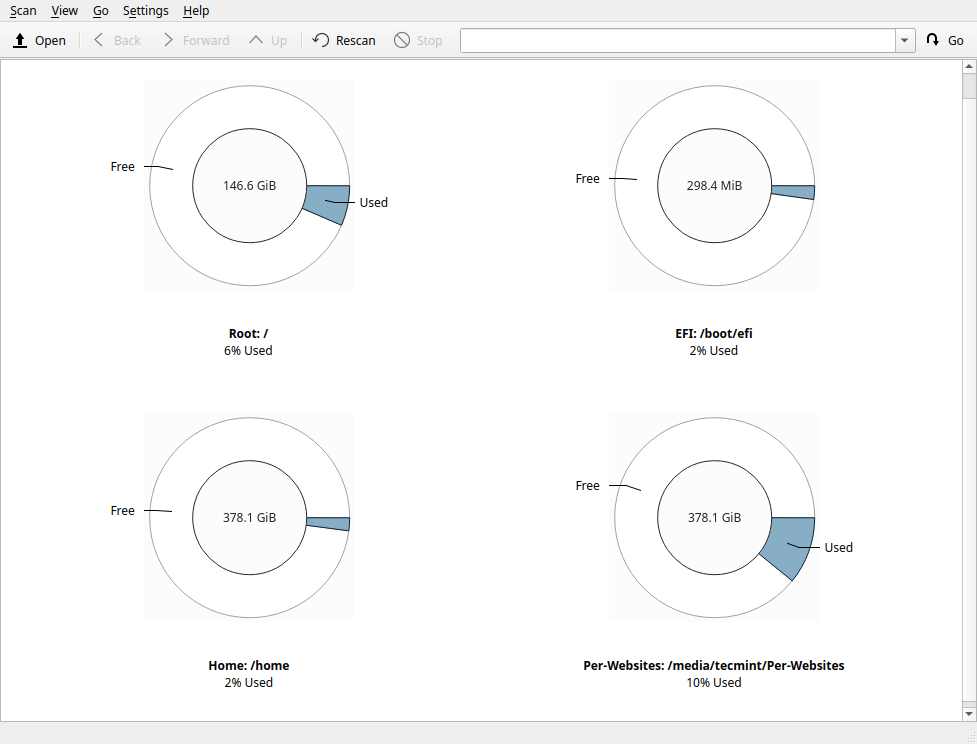
Show Linux Disk Space Summary

To view a file system in detail, simply click on it. You can move your mouse over the graphical layout to view files and sub-directories under it.
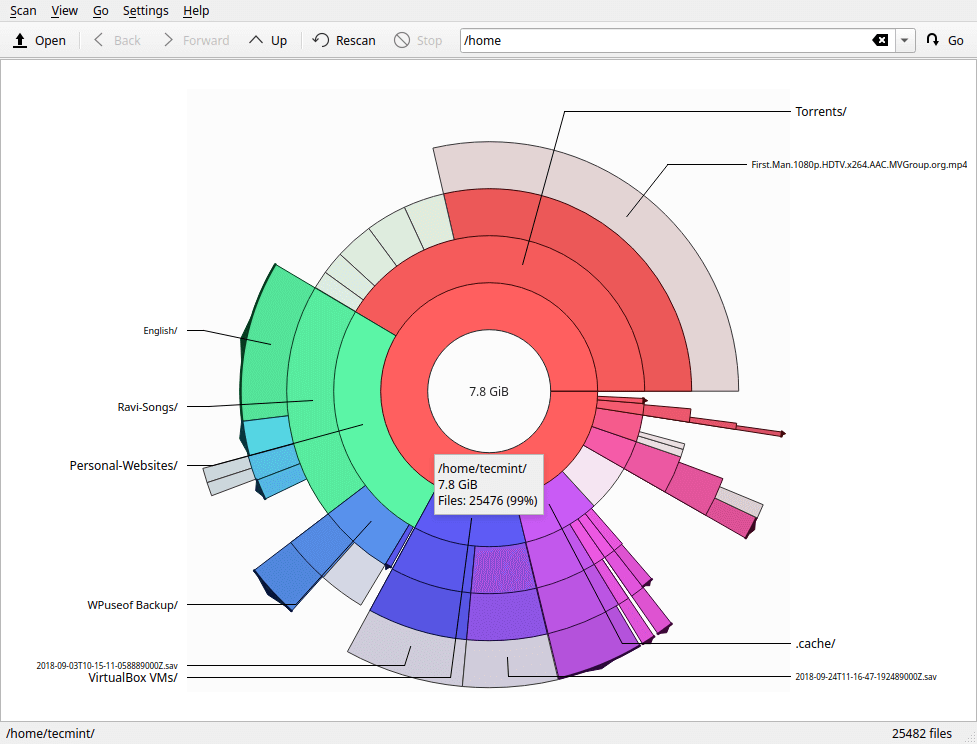
Linux Filesystem Disk Usage

The application also allows you to scan an individual folder/directory to identify hot spots (files and sub-directories occupying the largest space) in it. To do that, go to Scan -> Scan Folder, then select the folder you want to analyze (for example the Downloads folder), and click Choose.
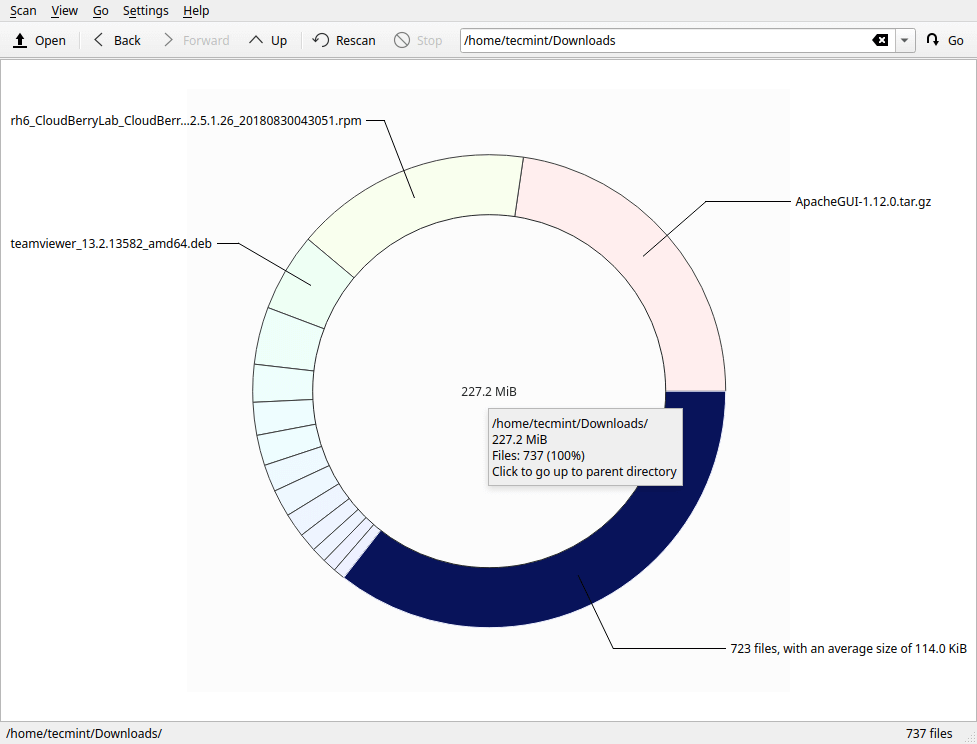
Show Disk Usage by File Size

There are many options under Scan; you can choose to Scan your home folder or root folder using the provided options.

Fileflight is also configurable under the Settings menu item. You can select the Toolbars to be shown; configure shortcuts, toolbars and the entire application.

Under the option Configure Fileflight, you can add or remove filesystems to or not to scan by clicking on the Scanning tab. You can also configure its appearance (color scheme, font size etc.) under the Appearance tab.

Fileflight Homepage: https://utils.kde.org/projects/filelight/

That’s all! Fileflight is a simple graphical disk analyzer for Linux systems and Windows operating system. Try it out and share your thoughts with us via the feedback form below.

If this article helped, with someone on your team.

TecMint Weekly Newsletter
Get the Learn Linux 7 Days Crash Course free when you join 34,000+ Linux professionals reading every Thursday.
Check your email for a magic link to get started.
Something went wrong. Please try again.
TecMint has been free for 14 years. Help keep it that way.
Google AI Overviews and tools like ChatGPT have cut into search traffic for independent tech sites like TecMint. Running this site costs over $2,000 every month for hosting, infrastructure, and paying authors to keep the content accurate and tested.

If this article helped you solve a problem, consider buying a coffee. It helps keep TecMint free, supports the authors, and keeps the project going.
☕ Buy Me a Coffee
Aaron Kili
Aaron Kili is a Linux and F.O.S.S enthusiast, an upcoming Linux SysAdmin, web developer, and currently a content creator for TecMint who loves working with computers and strongly believes in sharing knowledge.

Each tutorial at TecMint is created by a team of experienced Linux system administrators so that it meets our high-quality standards.

Got Something to Say? Join the Discussion...

Thank you for taking the time to share your thoughts with us. We appreciate your decision to leave a comment and value your contribution to the discussion. It's important to note that we moderate all comments in accordance with our comment policy to ensure a respectful and constructive conversation.

Rest assured that your email address will remain private and will not be published or shared with anyone. We prioritize the privacy and security of our users.

Free Course
Get a free Linux course before you go.
Subscribe to TecMint Weekly and get the Learn Linux 7 Days Crash Course free. Read by 34,000+ Linux professionals every Thursday.
Something went wrong. Please try again.
Check your email for a magic link to get started.